

To all my friends in procurement and trade-let's sit down and have a chat.
Whether you are in the restaurant business, food processing, or the export sector, the very first question that arises when sourcing garlic is invariably: "Which variety should I choose?"
On the surface, all garlic in the market looks much the same-just piles of gleaming white bulbs-but in reality, there is a great deal of nuance involved. Selecting the wrong variety can result in an incorrect pungency level, poor shelf life, or even failure to pass client inspections. Today, speaking from the perspective of an exporter, I' d like to walk you through the various classifications of garlic and the distinct characteristics of each.
I. Classification by Skin Color: White Garlic, Purple-Skin Garlic, and Solo Garlic
This is the most intuitive classification method and the one most commonly used in the market.
1. White Garlic (White-Skin Garlic) - The Export Mainstay
This is the most common variety found in the market; its skin is pure white or has a slightly creamy-yellow tint.
Characteristics: Large in size, uniform in shape, and features evenly sized cloves. Its pungency is relatively mild-not overly sharp or overpowering.
Storage Performance: Excellent shelf life! This is White Garlic's greatest advantage. Under cold storage conditions, it can be preserved for 8 to 10 months, or even longer. Consequently, White Garlic is the standard choice for long-distance ocean shipping and for ensuring cross-seasonal supply.
Suitable Applications: Exports to Europe, the Americas, and Southeast Asia; standard shelving in domestic supermarkets; and wholesale markets for dried goods.

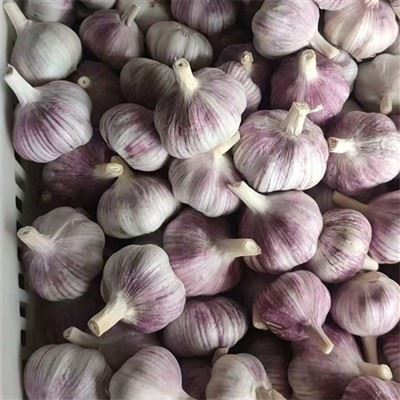
2. Purple Skin Garlic - The Pungency Powerhouse
This variety is easily recognizable by the distinct purple stripes running through its skin.
Characteristics: It typically contains fewer cloves than White Garlic, but its flavor is significantly more intense. Due to its higher allicin content, it delivers a powerful, sharp "kick" with every bite.
Storage Performance: Slightly inferior to that of White Garlic. Purple-Skin Garlic generally keeps for 5 to 6 months; after the spring thaw, it becomes prone to sprouting or drying out (becoming hollow).
Suitable Applications: Deep processing (producing garlic paste, flakes, or powder)-as its high pungency yields a more aromatic final product; regions with a preference for spicy foods; and the market for fresh garlic during the winter season.
3. Solo Garlic (Single-Clove Garlic) - The Choice for Premium Markets
Unlike other varieties, this garlic does not separate into individual cloves; instead, the entire bulb consists of a single, solid sphere.
Characteristics: Aesthetically pleasing in appearance, and offers highly consistent pungency-eliminating the common issue where "some cloves are spicy while others are not." Furthermore, it is incredibly easy to peel. Storage Performance: Similar to white garlic, but yields are lower, and prices are higher.
Suitable Applications: High-end supermarkets, Japanese/Korean restaurants, the gift market, and premium e-commerce offerings. Single-clove garlic is rarely sold via bulk wholesale channels; it is typically sold individually (by the piece).

II. Classified by Planting Season: Autumn-Sown Garlic vs. Spring-Sown Garlic
This classification method is typically only discussed by industry insiders.
Autumn-Sown Garlic: Planted in the autumn of the previous year and harvested in the summer of the following year. It has a long growth cycle, resulting in plump, juicy cloves with a rich, intense flavor. Autumn-sown garlic constitutes the bulk of our export volume. The major production regions in Northern China exclusively cultivate autumn-sown varieties.
Spring-Sown Garlic: Planted in early spring and harvested in late summer or early autumn of the same year. It has a short growth cycle, producing cloves that are smaller and denser; the pungency is often sharper, though the moisture content is lower. It is primarily cultivated in Northeast China and high-altitude, cold regions. Its market availability conveniently fills the supply gap left after the autumn-sown garlic season ends.
III. Classified by Usage: Fresh Garlic vs. Dried Garlic vs. Seed Garlic
Fresh Garlic: Just harvested from the field, having undergone neither artificial drying nor sufficient sun-drying. It is high in moisture and crisp, but extremely perishable-spoiling within just a few days. It is available on the market only during the few weeks following the annual new garlic harvest.
Dried Garlic: Fully sun-dried or artificially dried, resulting in a dry outer skin and low moisture content. This constitutes the bulk of the garlic traded in daily commerce, as it is suitable for both long-term storage and long-distance transport.
Seed Garlic: Cloves specifically set aside for use as planting stock. They must be free of disease and physical damage, with robust, well-developed growth buds. Seed garlic often commands a higher price than commercial-grade garlic, as the quality of the seed stock directly determines the success of the following year's harvest.
IV. Advice for Buyers
Do not base your decision solely on price.
If you are exporting to distant overseas markets or require storage for over six months, stick to white garlic. Ensure the specifications are uniform (e.g., 5.0–5.5 cm or 5.5–6.0 cm) and that the moisture content is sufficiently low.
If you are producing garlic pastes or sauces and require significant pungency, purple-skinned garlic is your best choice. Do not opt for white garlic simply to save money, only to find that it lacks the necessary heat to deliver the desired product flavor.
If you are targeting the high-end retail or gift markets, single-clove garlic-despite its higher cost-offers undeniable aesthetic appeal and convenience, which can effectively double your average transaction value. Let me leave you with a piece of honest advice:
In the garlic trade, the variety serves as the foundation. If that foundation is laid incorrectly, all subsequent efforts-processing, packaging, and shipping-will be entirely in vain. Whenever you are unsure, simply let us know your intended use and final destination; we will act as your first line of defense right here at the source.
Next time, we' ll discuss how to assess quality by examining the cloves and checking for dryness-tips you' re sure to find useful.


